A recent episode of the BBC Radio 4 programme ‘Sunday’ (that considers the ethical and religious issues of the week) included a news story about “the great church-goers’ schism of the 21st century.” Braced for something of the culture wars I was surprised instead to learn of the apparently thorny issue of church seating and the question of “pews or chairs?”
It seems many churches are eschewing traditional seating arrangements by removing their pews and switching to chairs. Two commentators presented ‘For and Against’ positions. Chairs, it was argued, add comfort and flexibility, are in tune with a ‘modern’, open, space. This opening gambit triggered memories of a conversation I’d had with a friend’s elderly mother, who bemoaned the loss of the pews in the church she had attended for more than 80 years. For her, church had always been a place for contemplation, which had been denied her when the pews were ripped out and chairs introduced. Particularly in her later years, Mrs. L’s preference had always been to sit at the back, and “have a good think”. She disliked, what for her, was an almost authoritarian demand to ‘participate’ implied when the chairs were set up as a circle.
I hope by now you’ll see why I think this story has relevance for those interested in Community of Enquiry, how spaces facilitate thinking, or constrain it, and issues related to the circle, The Round, that many will be familiar with.
In the ensuing discussion, on the one hand, one of the programme’s commentators stated “In our context, it was an urgent missional priority to remove barriers to certain people and groups experiencing the radical welcome of Jesus.” I’ve no beef with anyone committed to accessibility; to the contrary, it seems a worthy aim. But it’s another to direct this access at a specific mission; which, I argue, has an anti-democratic tenor observable also in some settings in which Community of Enquiry is practiced.
The claim here is based on geography, and the extent to which the spaces we practice in truly constitute a sense of place for those present. This is a critical issue for informal and community educators, like me, working in ‘non-institutional’ spaces, typically public space; and yet, arguably, it is an issue rarely considered in formal education settings.
Consider this photograph taken of an enquiry that took place during a philosophy walk, typically organised in the least ‘institutional’ of spaces, simply, outdoors.
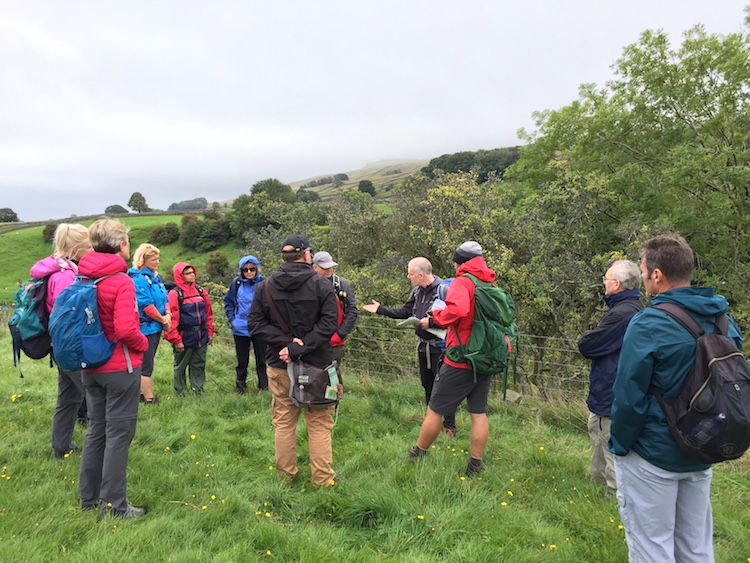
The group had been invited to make a circle. It is noticeable, though, that a few opt to stand outside, and others move closer, which tends to happen when they have hearing needs. Purposefully, I never make an issue of this, a position I take having long since reflected on philosophical workshops I’ve organised in youth clubs (which, by definition, are places of voluntary association: young people are free to come and go as they please). I remember one particularly well. A young man, albeit encouraged to take part, said he wasn’t interested. Fine. However, what I observed was him hanging around on the periphery of the room and, over time, getting closer, and closer. Whilst never actually joining the circle, he ended up close enough to chip in his own views; effectively, to engage with what was going on, to participate. And then there were the others who behaved similarly, albeit never saying anything. Might it be possible that the voiceless are engaged more than those who have a great deal to say? Might an emphasis on speaking drown out the value of listening?
The rationale here is based on the idea that there is value in the boundaries of our circles being fluid, porous, left open. Borrowing from the philosophy of street educators, and the language of those in French-speaking countries, this is a practice sans murs – without walls. The aim is to be responsive to individual mobility. In youth work we observe many young people determined to assert their spatial autonomy, pushing back in ways that would often be subject to sanction in schools. We want to celebrate these behaviours as expressions of power.
To return to the pews; the Sunday programme’s other commentator suggested that churches are a sanctuary from the “constant hullaballoo of modern life”. And of increasingly greater importance as there are “ever fewer spaces for calm and quiet reflection where we can reflect on matters personal, spiritual, theological.” And philosophical?
Furthermore, what was needed was the management of a church environment that conferred the “sensation of being alone, but in company”. In community? Without prescription.
- Further Thoughts and Questions
Yes, as with those with responsibility for churches, we should seek innovative and imaginative ways to set up the spaces we work in, particularly in terms of catering for those with additional needs. But it is another thing to confuse accessibility with a particular understanding of what that space is for. Sitting in the Round can certainly be more inclusive than other seating systems, but does it demand a form of participation that can itself be constraining of inclusion? Does a more mobile version of Community of Enquiry allow for multiple forms of engagement? Does it truly support freedom and security, autonomy and democracy? Where do we stand on the question of pews or chairs as metaphors for a range of important issues and questions in what are often claimed to be democratic practices?
0 Comments